
Plot Occurrence Map or Range Map of Individual Species
Source:R/plot_species_map.R
plot_species_map.RdCreates map visualizations of species ranges or species
occurrences. Requires an indicator_map object created using the
spec_occ_map() or spec_range_map() functions as input. It is
also the function called by plot() for species-level maps, including
those created with relative_occupancy_map(). To plot multi-species
indicators (e.g., species richness or evenness), use the plot_map()
function instead.
Usage
plot_species_map(
  x,
  species,
  single_plot = TRUE,
  title = "auto",
  auto_title = NULL,
  leg_label_default = NULL,
  suppress_legend = FALSE,
  xlims = NULL,
  ylims = NULL,
  trans = NULL,
  bcpower = NULL,
  breaks = NULL,
  labels = NULL,
  output_crs = NULL,
  crop_to_grid = NULL,
  crop_by_region = FALSE,
  ocean_fill_colour = NULL,
  land_fill_colour = NULL,
  grid_fill_colour = NULL,
  grid_line_colour = NULL,
  grid_line_width = NULL,
  grid_fill_transparency = NULL,
  grid_line_transparency = NULL,
  legend_title = NULL,
  legend_limits = NULL,
  legend_title_wrap_length = 10,
  title_wrap_length = 60,
  spec_name_wrap_length = 40,
  visible_gridlines = TRUE,
  visible_panel_gridlines = FALSE,
  map_expansion_factor = 0.5,
  layers = NULL,
  layer_colours = NULL,
  layer_fill_colours = NULL,
  scale = c("medium", "small", "large"),
  filter_outliers = FALSE
)
Arguments
- x
An 'indicator_map' object containing indicator values for individual species associated with map grid cells. This object is typically created using the
spec_occ_map(),spec_range_map()orrelative_occupancy_map()functions. This is a required parameter with no default.- species
Species you want to map. Can be either numerical taxonKeys or species names. Partial species names can be given as the beginning of a name (prefix match). This is a required parameter with no default.
- single_plot
(Optional) If TRUE, all species maps will be combined into a single multi-panel plot. Set this to FALSE to plot each species separately. Default is TRUE.
- title
(Optional) Plot title. Replace "auto" with your own title if you want a custom title or if calling the function manually.
- auto_title
(Optional) Text for automatic title generation, provided by an appropriate S3 method (if calling the function manually, leave as NULL).
- leg_label_default
(Optional) Default label for the legend, provided by an appropriate S3 method (if calling the function manually, leave as NULL).
- suppress_legend
(Optional) Do not show legend. This defaults to FALSE but will be forcibly set to TRUE when plotting species ranges, as all cell values are 1.
- xlims
(Optional) Custom longitude limits in decimal degrees (WGS84), as c(min, max). Should be supplied together with ylims. If only xlims is supplied, the values are instead interpreted in the units of the indicator_map's coordinate reference system and combined with the map's own y limits.
- ylims
(Optional) Custom latitude limits in decimal degrees (WGS84), as c(min, max). Should be supplied together with xlims. If only ylims is supplied, the values are instead interpreted in the units of the indicator_map's coordinate reference system and combined with the map's own x limits.
- trans
(Optional) Scale transformation for the fill gradient. Can be any transformation accepted by
ggplot2::scale_fill_gradient()(e.g., 'log', 'log10' or 'sqrt'), or one of the special values 'boxcox', 'modulus' or 'yj' (Yeo-Johnson), which use the power parameter given in bcpower.- bcpower
(Optional) Power parameter for the Box-Cox, modulus, or Yeo-Johnson transformations (used only when trans is 'boxcox', 'modulus' or 'yj').
- breaks
(Optional) Break points for the legend scale.
- labels
(Optional) Labels for legend scale break points.
- output_crs
(Optional) Coordinate Reference System (CRS) for the output map. Can be specified as an EPSG code (e.g., 4326) or a proj4string. If NULL (default), the original CRS of the indicator_map object will be used.
- crop_to_grid
(Optional) If TRUE, the grid will determine the edges of the map. If FALSE, a buffer will be added around the grid. If NULL (default), will be set to TRUE if map_level is "cube", otherwise FALSE.
- crop_by_region
(Optional) If TRUE, the map extent is set to the bounding box of the region that was specified when calculating the indicator_map (e.g. the country or continent), instead of the extent of the grid. This requires that a region was specified, i.e. that the indicator_map was not calculated with level = "cube" or level = "world". Default is FALSE.
- ocean_fill_colour
(Optional) Colour for the ocean (plot background) outside of the grid. Default is "#92c5f0" (light blue).
- land_fill_colour
(Optional) Colour for the land area outside of the grid. Default is "grey85".
- grid_fill_colour
(Optional) Colour for empty grid cells (non-empty grid cells will be coloured according to their indicator value). Default is "transparent".
- grid_line_colour
(Optional) Colour for the grid lines. Default is "black". If visible_gridlines is set to FALSE, this setting will have no effect.
- grid_line_width
(Optional) Width of the grid lines. If NULL (default), 0.5 for ISEA3H grids and 0.1 otherwise.
- grid_fill_transparency
(Optional) Transparency of the grid fill colour for empty grid cells (0 = fully transparent, 1 = fully opaque). If visible_gridlines is set to TRUE, default is 0.2. Otherwise, default is 0. Note that this setting does NOT apply to grid cells with indicator values, and has no visible effect while grid_fill_colour is "transparent".
- grid_line_transparency
(Optional) Transparency of the grid line colour (0 = fully transparent, 1 = fully opaque). Default is 0.5. If visible_gridlines is set to FALSE, this setting will have no effect. *Note that this setting does NOT apply to the grid outline!
- legend_title
(Optional) Title for the plot legend.
- legend_limits
(Optional) Limits for the legend scale.
- legend_title_wrap_length
(Optional) Maximum legend title length before wrapping to a new line.
- title_wrap_length
(Optional) Maximum title length before wrapping to a new line.
- spec_name_wrap_length
(Optional) Maximum species name length before wrapping to a new line. Default: 40 characters.
- visible_gridlines
(Optional) Show gridlines between cells. Default is TRUE.
- visible_panel_gridlines
(Optional) Show ggplot panel gridlines. Default is FALSE.
- map_expansion_factor
(Optional) Factor to expand the map limits beyond the grid limits. This does NOT expand the boundaries of the plot, it only affects where the crop is applied. If this value is too small, some land may be visibly cut off due to map distortion caused by projections. A larger value will extend the bounding box for cropping to prevent this. Must be a positive number. Default is 0.5. You can increase this value if you are using an extreme projection and find that some land is visibly cut off.
- layers
(Optional) Additional rnaturalearth layers to plot, e.g. c("reefs", "playas").
- layer_colours
(Optional) Outline colours for the additional layers, given in the same order as 'layers' (one colour per layer; must be the same length as 'layers'). If NULL (default), all layer outlines are black.
- layer_fill_colours
(Optional) Fill colours for the additional layers, given in the same order as 'layers' (must be the same length as 'layers'). If NULL (default), layers are unfilled, except "ocean" and "lakes", which are filled light blue.
- scale
(Optional) Scale of Natural Earth data ("small", "medium", or "large"). Default is 'medium'.
- filter_outliers
(Optional) If TRUE, removes geographical outliers from the plot extent using an Interquartile Range (IQR) method based on the centroid coordinates of the indicator_map cells. This is particularly useful for discrete global grids like ISEA3H where stray data points from coordinate errors can force the map bounds to expand globally. Default is FALSE.
Value
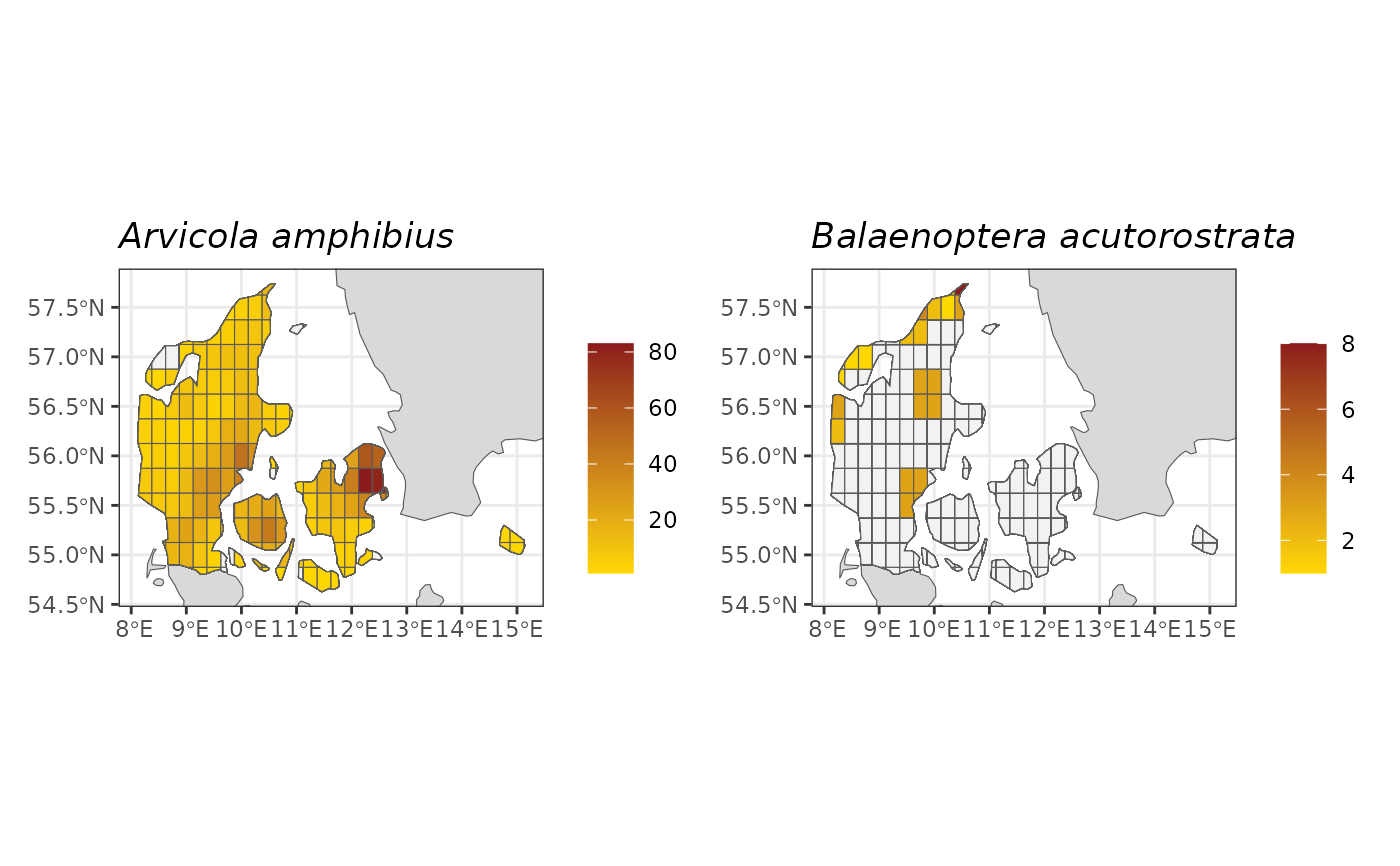
If single_plot = TRUE (default), a patchwork object combining one ggplot per species. If single_plot = FALSE, a named list of ggplot objects (one per species). These can be customized using ggplot2 and patchwork functions. Requires the 'patchwork' package.
Examples
# \donttest{
if (requireNamespace("patchwork", quietly = TRUE)) {
spec_occ_mammals_denmark <- spec_occ_map(example_cube_1,
level = "country",
region = "Denmark"
)
plot_species_map(x = spec_occ_mammals_denmark, c(2440728, 4265185))
}
 # }