
This function calculates bootstrap confidence intervals for an existing
indicator_ts object. It supports both cube-level bootstrapping (resampling
occurrence records) and indicator-level bootstrapping (resampling the
per-year components of the indicator), allowing for advanced
transformations during the CI calculation process.
Arguments
- indicator
An object of class
indicator_tsto which confidence intervals should be added.- num_bootstrap
(Optional) Number of bootstrap replicates to perform. (Default: 1000)
- bootstrap_level
(Optional) Level at which to perform bootstrapping:
auto(default): Usescubeif the dubicube package is installed, and otherwise falls back toindicator(with a message).cube: Bootstrapping is done by resampling the occurrence records in the cube, using the dubicube package. This is statistically more robust as it captures the underlying sampling uncertainty. Requires dubicube.indicator: Within each year, the component values of the indicator (occurrence records, species, or grid-cell values) are resampled with boot, without recalculating the indicator from a resampled cube. This is faster for large cubes but less robust, and does not require dubicube.
The level that was used is stored in the
ci_methodelement of the returned object and shown when it is printed.- ci_type
(Optional) Type of bootstrap confidence intervals to calculate. (Default:
"perc"). Supported options are:perc: Percentile intervals.bca: Bias-corrected and accelerated intervals.norm: Normal approximation intervals.basic: Basic bootstrap intervals.none: No confidence intervals calculated; the indicator is returned unchanged (with a message).
- trans
(Optional) A function for transforming the indicator values before calculating confidence intervals (e.g.,
log). At indicator level it is passed toboot::boot.ci()ash(not used for Hill numbers). Thetrans/inv_transarguments are ignored for evenness indicators at cube level, which always use the logit transformation unless overridden viaboot_argsorci_args. (Default: identity function)- inv_trans
(Optional) The inverse of the transformation function
trans(e.g.,exp). Used to back-transform the intervals to the original scale. At indicator level it is passed toboot::boot.ci()ashinv. (Default: identity function)- confidence_level
(Optional) The confidence level for the calculated intervals (e.g., 0.95 for 95% CIs). Used at both bootstrap levels. (Default: 0.95)
- overwrite
(Optional) Logical. If the indicator already contains confidence intervals (
llandulcolumns), should they be replaced? (Default: TRUE)- boot_args
(Optional) Named list of additional arguments passed to
dubicube::bootstrap_cube()(cube level only). (Default:list())- ci_args
(Optional) Named list of additional arguments passed to
dubicube::calculate_bootstrap_ci()(cube level only). (Default:list())- seed
(Optional) Integer. Random seed for bootstrapping, used at both bootstrap levels. The random number generator state of the session is restored afterwards. Use
NAto not set a seed. (Default: 123)- ...
(Optional) Additional arguments passed to
calc_ci()(indicator level only).
Value
The input indicator_ts object, with the bootstrap level used
stored in its ci_method element ("cube" or "indicator") and the
following columns added to its data:
ll: Lower limit of the confidence interval (negative lower limits are set to 0).ul: Upper limit of the confidence interval.
Except for Hill numbers (whose intervals come from iNEXT), the following columns are also added:
int_type: The type of interval calculated (e.g.,"perc").conf: The confidence level used.est_boot: The bootstrap estimate of the indicator value.se_boot: The bootstrap standard error.bias_boot: The bootstrap estimate of bias.
At cube level, est_boot, se_boot and bias_boot are only returned
for some indicators (e.g., total_occ, spec_occ and spec_range),
depending on the bootstrap method and bias correction used.
If ci_type = "none", or if confidence intervals cannot be calculated
for the indicator, the input object is returned unchanged.
Details
For cube-level bootstrapping, the function acts as a bridge to the
dubicube package (Langeraert et al.), which is developed alongside
b3gbi within the B-Cubed project. dubicube is not on CRAN; it
can be installed from R-universe with
install.packages("dubicube", repos = c("https://b-cubed-eu.r-universe.dev", "https://cloud.r-project.org")).
Indicator-specific defaults
Depending on the indicator, default settings are internally applied when calculating bootstrap confidence intervals. These defaults control whether bootstrapping is performed per group, which transformation is used, and whether bias correction is disabled.
The following defaults are used unless explicitly overridden via
trans, inv_trans, boot_args, or ci_args:
total_occGroup-specific bootstrapping: yes
Transformation: none (identity)
Bias correction: disabled (
no_bias = TRUE)
spec_occ,spec_rangeGroup-specific bootstrapping: no (whole-cube resampling, with intervals per year and species)
Transformation: none (identity)
Bias correction: enabled
pielou_evenness,williams_evennessGroup-specific bootstrapping: no
Transformation: logit
Inverse transformation: inverse logit
Bias correction: enabled
occ_density,ab_rarity,area_rarity,newnessGroup-specific bootstrapping: no
Transformation: none (identity)
Bias correction: enabled
Group-specific bootstrapping means that resampling is performed within each group (e.g., year), which is required for indicators that are inherently group-based. This is in contrast to whole-cube bootstrapping, where resampling is performed across the whole dataset; this is applicable to indicators that combine information across groups.
Transformations are applied prior to confidence interval calculation and inverted afterwards to return intervals on the original scale.
These defaults (grouping, the logit transformation for evenness and the
disabled bias correction for total_occ) apply to cube-level
bootstrapping. At indicator level, trans and inv_trans are passed to
boot::boot.ci() for all indicators (including evenness) except Hill
numbers.
Indicators outside scope of this function
For certain indicators, confidence intervals cannot be calculated or
added post-hoc because they are not statistically relevant, or because
proper uncertainty estimation is not supported. In such cases, a warning
is issued and the original object is returned. The following indicators
cannot have confidence intervals added via add_ci():
obs_richness,spec_richness_density: Observed species richness and richness density are highly sensitive to sampling effort and sample size. Furthermore, bootstrapping observed occurrences can never discover new/unobserved species, meaning resampled richness estimates are always less than or equal to the observed richness. This results in confidence intervals that lie entirely at or below the observed value (i.e., the upper bound cannot exceed the observed richness). Therefore, post-hoc bootstrapping is not a statistically sound way to estimate their uncertainty (Hill numbershill0,hill1,hill2should be used instead for proper rarefaction/extrapolation).completeness: Sample completeness (coverage) is calculated as a deterministic sample statistic usingiNEXTmethods, and confidence interval calculation is not supported.relative_occupancy: Standard bootstrapping is not supported because resampling strips spatial attributes (liketotal_num_cellsortotal_area_sqkm) necessary for occupancy calculation. These spatial attributes cannot be regenerated from the resampled occurrences alone, as occurrences only capture cells/regions where species were detected and contain no information about empty grid cells (zero occurrences) in the study area.cum_richness(Cumulative Species Richness): This is an inherently temporal and sequential indicator for which CIs are not generated, as its nature as an accumulating count over time is not well-suited to standard bootstrapping methods for uncertainty.occ_turnover(Species Turnover): Confidence intervals are not calculated for this indicator. The metric's reliance on comparing the unique species lists between consecutive time steps means that bootstrapping individual observations within each time step would introduce artificial variability in these lists. This makes the resulting gains and losses highly unstable and would lead to unreliable or biased confidence intervals for the turnover metric.tax_distinct(Taxonomic Distinctness): Confidence intervals are not calculated for this indicator. Due to its high sensitivity to the exact species composition and taxonomic relationships within a sample, bootstrapping individual occurrences can introduce significant artificial variability, leading to unreliable or biased confidence intervals.
Note: For Hill numbers (hill0, hill1, hill2), cube-level
bootstrapping is not supported natively, but add_ci() will automatically
switch to indicator-level bootstrapping and calculate confidence intervals
internally using the iNEXT package.
Examples
# \donttest{
# Load sample cube data
cube_path <- system.file("extdata", "denmark_mammals_cube_eea.csv", package = "b3gbi")
cube <- process_cube(cube_path)
# Calculate a time series indicator
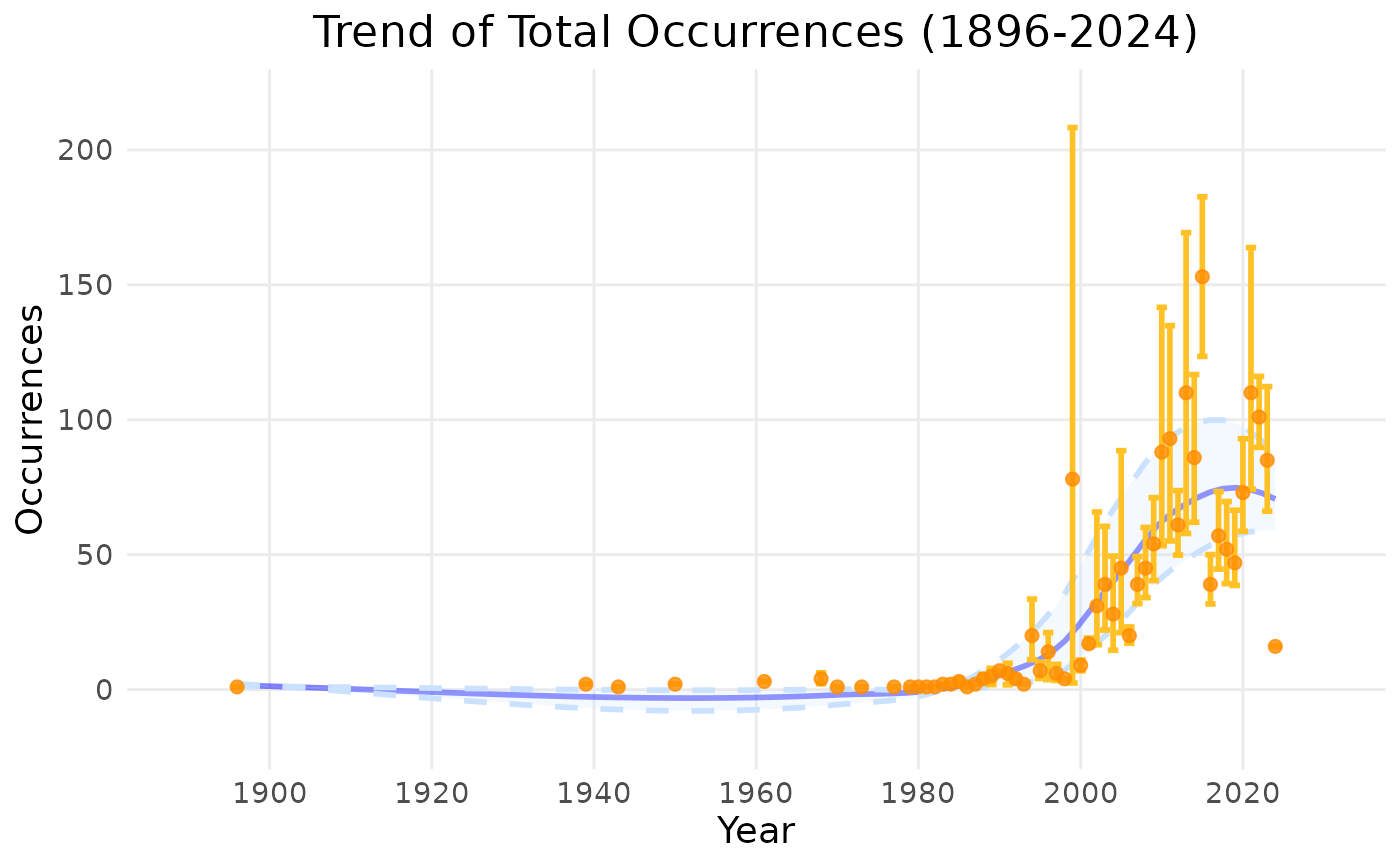
ts_occ <- total_occ_ts(cube)
# Add bootstrap confidence intervals
ts_occ_ci <- add_ci(ts_occ, num_bootstrap = 100)
#> [1] "Performing group-specific bootstrap with `boot::boot()`."
plot(ts_occ_ci)
 # }
# }